Behind the research headline
Tirzepatide discontinuation: when stopping treatment and leaving a study differ
The meaning of a stopping percentage depends on the event definition, the people counted and the observation that continues afterward. An evidence-focused reading of tirzepatide research.
Published · 12 minute read
Stopped is an incomplete description in a research headline. It needs an object: what stopped, under which definition, and what information remained observable afterward? A number can be calculated accurately yet answer a different question from the one a reader has in mind. The first task is to reconstruct that question before treating the result as a judgment about success, tolerability or the value of continuing care.
This analysis uses a selected figure as the starting point for original methodological interpretation. The study quantities and their context appear together below. The discussion develops the information needed to move from an endpoint count to a claim about individual pathways, later outcomes or causes. Those inferential steps matter because a plausible explanation and a demonstrated relationship are different kinds of evidence.
Wide tables can scroll horizontally. Keyboard users can focus a table region and use the arrow keys to move across it.
Reading the evidence
- Name the event
- An endpoint needs an explicit action, qualifying reason and observation rule.
Sources: [2]
- Preserve joint information
- Marginal totals do not reconstruct which records overlap or the order of events.
Sources: [2]
- Follow the observation process
- Exposure status and availability of an outcome measurement answer different questions.
Sources: [2]
- Specify the causal comparison
- A comparison of recorded outcomes does not itself define the effect of a treatment decision.
Sources: [2]
- Keep clinical assessment separate
- An aggregate endpoint is not a personal rule for continuing, stopping or changing treatment.
Sources: [4]
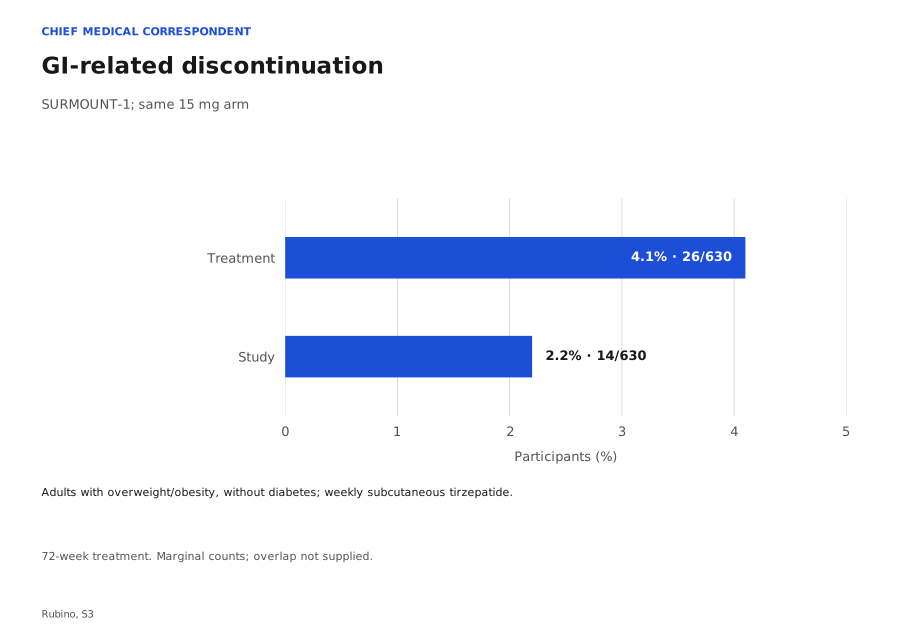
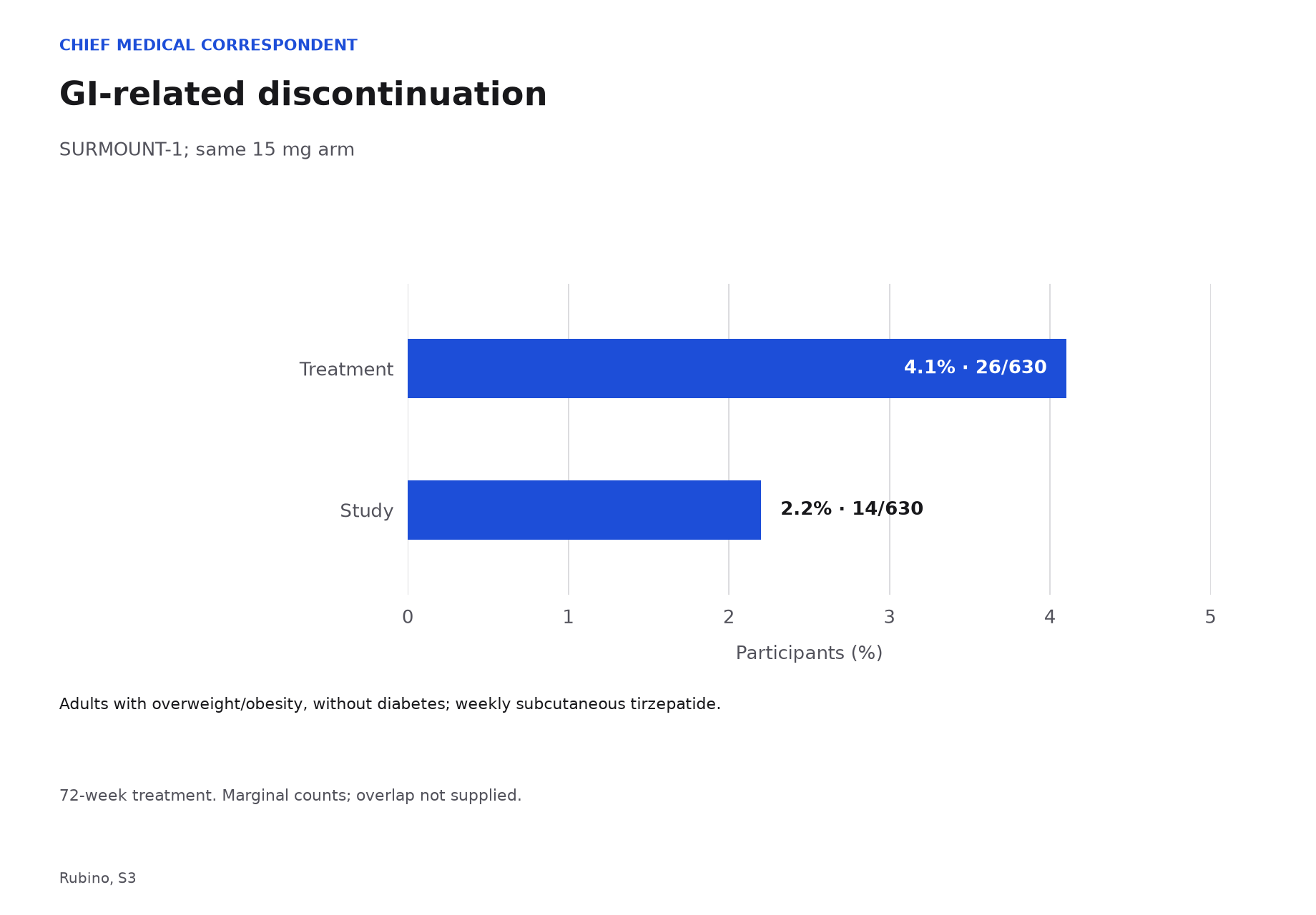
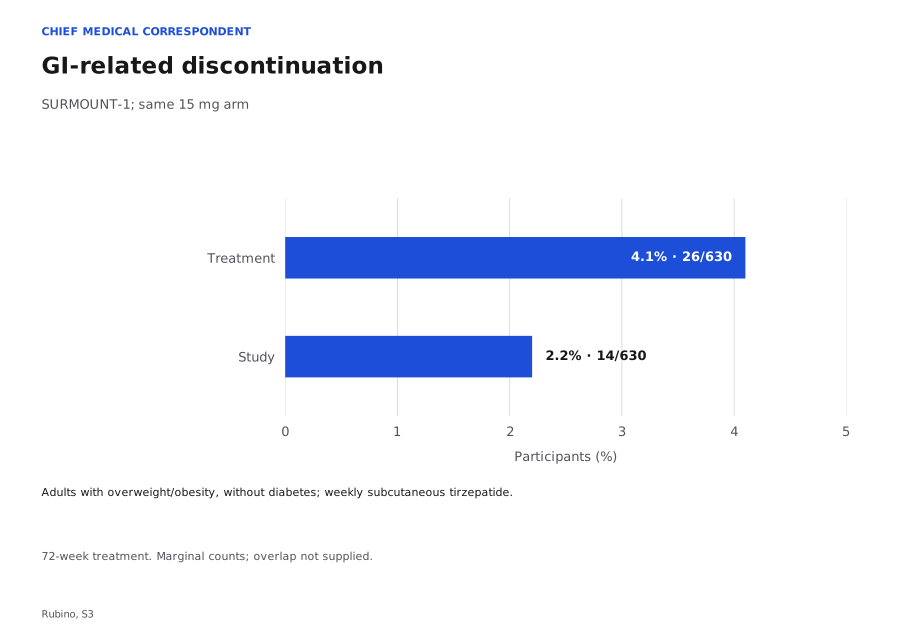
GI-related discontinuation
SURMOUNT-1; same 15 mg arm
Adults with overweight/obesity, without diabetes; weekly subcutaneous tirzepatide.
72-week treatment. Marginal counts; overlap not supplied.
Sources: [2]
| Ending | n/N | Percent |
|---|---|---|
| Treatment | 26/630 | 4.1% |
| Study | 14/630 | 2.2% |
Define the endpoint before judging the result
Rubino’s post hoc analysis was Lilly-funded; six authors were employee-shareholders. Its selected rows distinguish treatment discontinuation from study discontinuation.
An endpoint is a rule for turning experience into a recorded outcome. Before interpreting a stopping percentage, specify what action ends, which reason qualifies and what period the rule covers. An intervention, an appointment schedule and an outcome measurement are different objects. Ending one need not logically end the others. A headline that drops the object of the verb leaves the reader to supply an assumption that the number itself cannot resolve.
A useful way to examine such a definition is to ask which record would change its classification. A change in medication receipt would answer a treatment-status question; a change in participation would answer an observation-status question. Combining those questions creates a different endpoint and requires its own rule. This is why endpoint wording belongs in the scientific interpretation, alongside the size of the result. Precision here determines what evidence would count as agreement or disagreement with a claim.
Our guide to reading health-risk headlines explores another setting in which the outcome definition shapes the question.
Sources: [2]
Two totals are not a participant timeline
A marginal total counts membership in a category without showing how that membership intersects with another category. Imagine the underlying record as a set of separate status fields, not as a single exit label. A summary of each field removes the links between them. Knowing those summaries does not reconstruct a participant's sequence of decisions, contacts or measurements. That information has to survive in a joint record before it can support a statement about a pathway.
To investigate overlap, an analyst would need a cross-tabulation that classifies each participant against both endpoint definitions. To investigate order, the analyst would additionally need dates and rules for simultaneous or uncertain events. These are different requirements: a table of joint membership could establish overlap while leaving chronology unresolved. A timeline could also be incomplete if reasons were recorded inconsistently. The evidence needed depends on whether the proposed explanation concerns shared people, ordering or duration.
Subtracting marginal counts cannot create the missing links. Even where a protocol defines one category as nested inside another, that definition must be established before interpreting a difference. A subtraction would still not identify recovery, symptom resolution or the experience of a particular person. Those are additional outcomes. The scientifically useful response to an incomplete joint picture is to name the required record, rather than fill the gap with a plausible story.
Sources: [2]
Keep the reason and denominator together
A reason-specific endpoint applies an extra filter to an event. The underlying action must qualify, and the assigned reason must also qualify. Its complement therefore contains several logical possibilities: the action did not occur, it occurred for a different reason, or the available record did not meet the classification rule. Treating every record outside a selected category as a successful uninterrupted course collapses these possibilities into an unsupported conclusion.
The denominator requires the same attention. It identifies the population to which the fraction refers; it is not a label for everyone who remained under observation until the end. A stopping outcome can require retaining people in an analysis precisely because they stopped. Redefining the denominator around completion would change the question. Before comparing reports, an analyst should establish which people were eligible to contribute and whether that eligibility was fixed before outcomes occurred.
Reason coding can introduce another layer. A new analysis would need to specify whether multiple reasons may be recorded, whether one takes priority and how uncertain attribution is handled. Without that specification, differences in classification could be mistaken for differences in experience. These are design questions to investigate, not claims about an undocumented procedure in the research shown here.
For the separate clinical discussion, see our digestive side-effects guide.
Sources: [2]
Follow treatment and observation separately
Treatment receipt and outcome observation should be represented as separate processes. A participant may change exposure while remaining available for measurement, or a scheduled measurement may be unavailable while exposure continues. The scientific question determines which information matters. An analysis of an assigned care strategy asks about consequences of assignment under a defined policy. An analysis restricted to exposure periods instead asks about a narrower experience. Neither description is complete until the handling of later changes is stated.
This distinction matters when interpreting weight measurements alongside a stopping endpoint. The existence of a stopping record does not tell the reader whether a later outcome was measured, included or excluded from a particular estimate. Each of those is a separate question. An outcome could exist in a database yet be omitted by an analysis rule; conversely, an intended follow-up schedule does not prove that every measurement was obtained. Data collection and analytical inclusion must be examined independently.
A clear account would align exposure dates, observation dates and the target question before calculating a comparison. Otherwise, the reader may interpret an estimate as describing a complete assigned strategy when it describes only a selected period. The issue is the meaning of the estimate, not a presumption that one analytical approach is automatically preferable.
Our weight-regain discussion addresses a different question that also depends on what happens after exposure changes.
Sources: [2]
Ask what missing outcomes could change
Missingness becomes informative when whether an outcome is observed depends on circumstances related to that outcome. This is a possible mechanism to examine, not a finding established by a pair of endpoint counts. The relevant investigation asks what predicts observation, what information remains available after a missed measurement and how those predictors relate to the outcome of interest. A label such as lost to follow-up does not, by itself, answer those questions.
An analysis restricted to observed measurements may describe a different population from the one originally targeted. To evaluate that possibility, investigators could compare available characteristics across observation patterns and consider whether measured information explains the differences. Such comparisons cannot prove that unmeasured influences are absent. They can make the assumptions clearer and reveal where an estimate relies heavily on information that was never observed.
Sensitivity analysis then asks how the conclusion changes under alternative, explicitly stated assumptions about unavailable outcomes. It should describe which assumption varies and why that variation is scientifically plausible. It does not recover unknown measurements by declaration. Nor does an endpoint count identify the direction of any resulting bias. A responsible interpretation separates a demonstrated result from the assumptions needed to extend it beyond the observed information.
Sources: [2]
Randomized treatment does not randomize later decisions
Randomization concerns the allocation made by a trial's assignment procedure. It does not automatically confer the same protection on comparisons formed afterward. Symptoms, changes in exposure and decisions about participation may depend on many influences. If an analysis groups people according to such later events, the groups can differ in ways that are relevant to the outcome. Their comparison therefore requires a new explanation of what is being estimated and which assumptions support it.
This also distinguishes comparison of treatments from comparison of endpoint labels. Measuring different outcomes within a common group can describe different aspects of that group's experience. It does not create another randomized intervention. The difference between those outcomes is not an effect of choosing one action over another. To estimate that effect, a study would need an explicit decision contrast, a defined starting point and suitable information about factors influencing both the decision and the subsequent outcome.
A biological explanation does not remove this requirement. A mechanism can help formulate a hypothesis, but a causal estimate still depends on a comparison that addresses the question. Plausibility, temporal ordering and descriptive frequency each contribute different information. Treating any one of them as a complete substitute for a causal design skips the central inferential step.
The GLP-1 mechanism guide provides context for keeping biological questions distinct from endpoint comparisons.
Sources: [2]
Design the comparison needed for a new claim
Suppose the proposed claim changes from describing a stopping endpoint to evaluating an additional support service. The intervention has now changed, so the necessary evidence changes too. A useful study would define the support being offered, the comparison condition, the people eligible to receive it and the outcomes to be collected. It would also specify whether an apparent difference could arise from altered reporting or contact patterns rather than a change in the experience being studied.
That last distinction is especially relevant when an intervention changes access to communication. More opportunities to report symptoms could alter recorded event frequency even if the underlying experience were unchanged. Better retention of contact could alter outcome completeness without establishing a medication effect. These are hypothetical mechanisms a design should distinguish, not findings about a particular service. Recording both experience and observation helps prevent the measurement process from being mistaken for the treatment effect.
The table outlines original design questions, not tested benefits. Each proposed comparison needs an outcome definition that is stable across groups. A study addressing a different formulation would also need to identify that preparation explicitly; a shared molecule name alone cannot establish that all clinically relevant features are shared.
Our compounding overview supplies separate context for questions about the product being discussed.
| Proposed question | Comparison and records needed | Assumption to examine |
|---|---|---|
| Does added support change the outcome? | Defined support and comparison conditions; consistent outcome collection | Whether reporting opportunities differ between groups |
| Does a different preparation change the outcome? | Precisely identified preparations and a suitable comparison | Whether the compared groups and exposure periods are comparable |
| Does a continuation decision affect later health? | A defined decision point, later outcomes and determinants of the decision | Whether factors influencing both the decision and outcome are addressed |
Sources: [2]
What a complete follow-up record would contain
A useful follow-up record would preserve several dimensions rather than reduce every participant to a single success or failure. Exposure status indicates what was received. Contact status indicates whether observation remained possible. Outcome status identifies what was actually measured. Reasons and dates connect these dimensions, while explicit uncertainty fields prevent an unknown status from silently becoming an absence of an event. This structure supports several questions without assuming they all have the same answer.
The event date and the date a researcher learned about it should also remain distinguishable. They answer different timing questions. An observation learned later may refer to an earlier interval, and a scheduled visit date need not mark the beginning of a change. A new analysis would need rules for uncertain dates, interrupted records and competing interpretations before calculating a duration or ordering events. Otherwise, a tidy timeline could conceal decisions made after looking at the outcomes.
The original table below describes information requirements. It does not claim that an accessible summary exhausts the information collected by investigators. Published aggregate tables and participant records serve different purposes, and a limitation of the reader's access is not proof that a variable was never measured.
Our medical-review and evidence guide separates the status of a publication from the strength of its supporting evidence.
| Scientific question | Record required | Unresolved interpretation without it |
|---|---|---|
| Who meets both endpoint definitions? | Joint membership under explicit classification rules | Whether marginal totals refer to overlapping people |
| Which event preceded another? | Aligned event dates, reporting dates and uncertainty flags | The sequence of changes |
| What happened after exposure changed? | Exposure history linked to subsequent outcome observations | The later outcome under the intended analytical question |
Sources: [2]
Keep individual decisions with clinical care
Current Zepbound prescribing information lists personal or family medullary thyroid carcinoma, MEN2, and serious hypersensitivity to tirzepatide or its ingredients as contraindications. Rodent thyroid tumors underlie the boxed warning; the relevance to humans is unknown. Pancreatitis, gallbladder disease, dehydration-related kidney injury and severe gastrointestinal reactions require attention. Use is not recommended with severe gastroparesis. Seek prompt assessment for severe or persistent abdominal pain, contact a clinician about ongoing digestive symptoms, and notify an anesthesia team about treatment.
Group summaries cannot select an individual's next treatment action. That decision needs the person's symptoms, history, current product and clinical assessment. Reading a stopping endpoint correctly helps prevent a research number from being turned into a personal threshold. It does not supply a reason to wait through concerning symptoms, alter a dose or continue solely to resemble a study category. The analytical question and the clinical decision require different information.
Our gastroparesis guide discusses a separate clinical topic; the endpoint figure does not diagnose it.
Sources: [4]
The next question the data should answer
The strongest next question is specific enough to determine the data that would answer it. If the interest is overlap, request joint endpoint membership. If the interest is sequence, request aligned dates and reason records. If the interest is later health outcomes, establish an observation plan that continues to address the chosen target after exposure changes. These requests lead to different analyses, so an unspecified demand for more follow-up is less useful than a defined scientific question.
A further step is to state in advance what evidence would change the interpretation. A clearer endpoint definition could resolve a classification ambiguity without adding participants. Additional outcome measurements could improve follow-up while leaving causal confounding unresolved. A suitable comparison could address a causal question while still depending on assumptions about missing information. Thinking in these separate layers avoids expecting one additional table to settle every uncertainty.
The reporting task is therefore to connect each inference to the information it requires. A descriptive total can be informative on its own terms, while a claim about a pathway, cause or clinical decision requires additional structure. Keeping that structure visible gives the reader a more useful account than treating every kind of ending as the same result.
Our companion semaglutide analysis examines how a different measurement choice shapes a safety headline.
Sources: [2]
Questions about the evidence
Why does the object of the word stopped matter?
An endpoint records a defined event. Ending exposure, ending observation and becoming unavailable for a particular measurement are logically different possibilities. If the object disappears from a summary, the reader may substitute a different event and draw a conclusion that the statistic was never designed to support. Restore the complete definition before interpreting its size.
Sources: [2]
Can the difference between marginal totals identify a subgroup?
Not without the joint classification rule and the underlying overlap information. Marginal summaries discard the links between individual records. Even a justified numerical difference would not identify a clinical state such as recovery unless that state was separately defined and measured. A participant-level cross-tabulation and an outcome assessment answer different parts of that question.
Sources: [2]
What does a reason-specific endpoint leave unresolved?
It leaves the other possible reasons and the classification of uncertain records unresolved unless those are reported separately. Being outside a selected reason category does not establish uninterrupted exposure or complete observation. Interpretation requires knowing both the qualifying event and the extra reason filter, rather than treating their complement as a single favorable outcome.
Sources: [2]
Does continued contact guarantee complete outcome data?
No. Availability for contact and availability of a specified measurement are different statuses. A defensible analysis identifies the measurement, its intended timing, whether it was obtained and how any absence was handled. It also distinguishes a collected observation from one included in an estimate. These distinctions determine which scientific question the available data can address.
Sources: [2]
What would support a claim that an intervention prevents stopping?
A suitable comparison would define that intervention, the alternative, the target population and the stopping endpoint in advance. It would need consistent observation and a strategy for factors that influence both the intervention received and the outcome. A descriptive count cannot supply this design retrospectively, even when a proposed explanation sounds biologically or practically plausible.
Sources: [2]
Editorial assessment
The central interpretive task is to preserve the links between an event definition, the people eligible to contribute and the observation process. Marginal endpoint summaries describe selected features of experience; joint records are needed for overlap, aligned histories for sequence, and suitable comparisons for causal claims. A useful research account states which of those questions it answers and what evidence would be required for the next one. That approach allows a stopping statistic to remain informative without turning it into a participant narrative or an individual treatment instruction.
Sources and access
- Wharton (2022): semaglutide tolerability
Article and supplement checked.
Checked .
- Rubino (2025): tirzepatide tolerability
Article and supplement checked.
Checked .
- DailyMed: Wegovy prescribing information
Current official label checked.
Checked .
- DailyMed: Zepbound prescribing information
Current official label checked.
Checked .